How it works
- Bring the draft you have. Paste your essay or upload a plain text file. If a question accompanies the assignment, keep that question with the draft rather than relying on the reader to infer it.
- Read with a purpose. Look at the sample feedback beside the passage it discusses. Notice whether the comment concerns the order of ideas, a supporting detail, or the meaning of a particular sentence.
- Choose your next revision. Return to the passage, decide what you meant to communicate, and make the change in your own language. Keep a copy of the earlier draft so you can assess what changed.
Begin with a concern you can locate in the draft. If the middle repeats the opening, examine progression. If a claim feels unsupported, examine the detail behind it. A revision has a clearer purpose when you can point to the passage it needs to address.
What we grade
Each review is scored on the five dimensions below, with a sample output shown.
| Dimension | What we measure |
|---|---|
| Structure | Paragraphs move the essay forward: an engaging opening, a meaningful turn, and a clear landing. |
| Specificity | Concrete, verifiable details support the writing instead of general statements. |
| Voice | The writing sounds like the author rather than a polished, generic composition. |
| Language | Sentences are clear, accurate, and concise, without unnecessary wording. |
| Closure | The ending reaches a specific insight rather than repeating a summary. |
Overall = (Structure + Specificity + Voice + Language + Closure) / 5, rounded to one decimal place.
For a general draft, start with the relationship between the paragraphs. A clear opening gives the reader a place to begin; the middle needs to develop what the opening sets in motion. Check whether a paragraph adds an action, observation, or change in understanding. If it repeats the previous paragraph's conclusion, consider what purpose it serves before refining individual sentences.
Specificity and voice work together. A detail helps when it supports the meaning you intend, and its phrasing should still sound like you. Do not add a scene you cannot honestly describe or replace ordinary language with a more impressive synonym. Language feedback concerns clarity and precision within that account. Closure concerns the particular understanding the ending reaches, rather than a broad claim about everything you learned.
All five dimensions have equal weight. The example scores illustrate the formula and presentation of feedback; they do not evaluate the draft in your editor. Read a dimension score with the comment beside it, then find the passage that supports the concern.
Example feedback
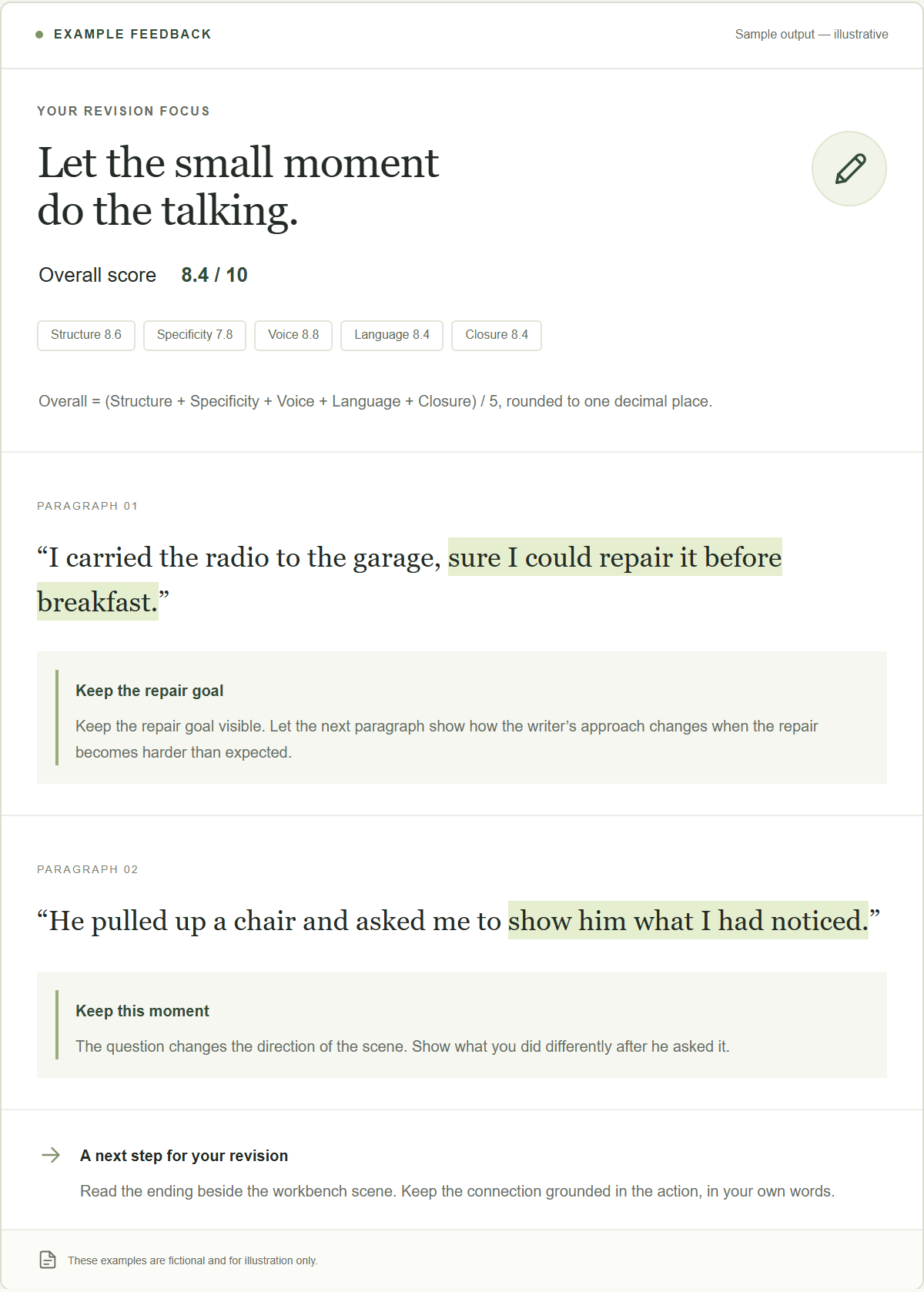
The example centers on a fictional scene at a workbench. A comment points to a particular exchange and invites the writer to examine its role in the scene. The screenshot captures the actual interface; the comments are illustrative. It does not represent an AI evaluation, a student submission, or an admission result.
How to use the feedback
Use the specified areas to organize questions about your draft. A question about structure belongs beside the order of the paragraphs. A question about specificity belongs beside the claim or observation it concerns. Keeping those connections visible makes it easier to decide what a change would accomplish.
Before changing a paragraph, write down its purpose in your own words. Compare that purpose with what is actually on the page. If the relationship is unclear, return to the experience or idea you intended to convey. Decide what the reader needs before choosing new wording.
Keep the original version beside a revision. Read both passages in context, including the paragraph before and after them. A change is useful when it helps express the meaning you intended, rather than merely making the sentence sound different. You remain responsible for the words you submit.
Review an application draft
When using an essay grader for an application draft, keep the application question close at hand. General writing feedback and prompt-specific review ask related questions, but the question attached to the essay still matters. For a draft responding to the main Common App essay, the Common App Essay Grader provides a focus on the selected question.
Common mistakes
- Filling the draft with abstract adjectives. Words such as “meaningful” or “challenging” can name an impression without showing the experience behind it. Locate the statement before deciding what supports it.
- Summarizing in every paragraph. Repeated summaries may leave little room for the actual moment or idea the writer wants to explore. Read the paragraphs together and notice what each contributes.
- Reading a comment without its passage. The surrounding sentences can change what a suggestion means. Keep the text and the comment beside each other while considering a revision.
- Changing everything at once. A large set of simultaneous edits makes it harder to understand which change addressed the concern you identified. Preserve the earlier draft for comparison.
- Confusing a different word with a clearer idea. Replacing vocabulary does not resolve uncertainty about what a sentence means. Decide on the meaning before choosing a new phrasing.
- Accepting phrasing you would never use. The writer’s choices matter. If a suggestion sounds unfamiliar, express the underlying idea in language that fits the rest of the draft.
- Treating the ending as an isolated sentence. Read the closing passage beside the material that comes before it. Consider the relationship rather than judging the last line alone.
- Expecting a score to settle every revision decision. A number cannot tell you which words reflect your experience. Keep attention on the comment, its evidence, and your intended meaning.
When to use
Choose Essay Grader when you want to examine the specified general writing areas. Choose Admission Essay Review when your question concerns prompt response and the impression left by an application draft. Choose the Common App review tool when the draft needs to be read alongside a selected Common App prompt. The tools overview explains the review scopes.
Frequently asked questions
How does an essay grader evaluate a draft?
An essay grader needs a defined rubric so that each comment refers to something observable in the writing. Admissa uses Structure, Specificity, Voice, Language, and Closure with equal weight. The overall score is their average, rounded to one decimal place. Read each dimension beside its explanation and the passage it concerns.
Can an essay grader predict an admission decision?
An essay score cannot establish what an admission decision will be. An application contains information beyond a single piece of writing, and a review does not reproduce a college’s decision process. Use comments to identify passages worth revisiting. Treat the review as an input to your revision rather than an outcome forecast.
What should I include with an essay for feedback?
Keep the question you are answering beside the draft. The prompt helps a reader understand what the piece is trying to accomplish. Include the essay text itself rather than a list of what you intend to write. Avoid including identifying details that are unnecessary for understanding the passage you want to examine.
How should I use line-by-line essay feedback?
Read a comment together with the surrounding paragraph before deciding on a change. A sentence may sound clear by itself while interrupting the movement of the piece. Decide what the passage needs to communicate, then revise in words you would actually use. Read the changed paragraph again to check its relationship with the whole draft.
Can I upload an essay instead of pasting it?
The workspace accepts a plain text file through the upload button or a file drop. You can also paste the essay directly into the editor. Check the imported text before working with it, especially paragraph breaks and punctuation. Keep a separate saved copy so that you can return to the original wording.
Is the example feedback based on my essay?
The example view uses a fictional draft and illustrative comments. It is separate from anything you paste into the editor. Compare the sample passage with its annotation to understand the feedback format. Do not treat its scores as results for your own essay or as evidence of an admission outcome.
What does specificity mean in essay feedback?
Specificity concerns the details a reader can locate in the passage. A concrete action, exchange, or observation gives a general statement something to rest on. The aim is to examine which details support the meaning you intend. Adding description simply to make a paragraph longer does not necessarily make that meaning clearer.
How can I keep my voice when revising an essay?
Treat suggestions as questions about the draft rather than sentences you must copy. Read a proposed change aloud and consider whether you would say it that way. Keep choices that express your meaning accurately. If a revision sounds polished but unfamiliar, return to the idea and find a phrasing that belongs to you.
Should I revise grammar before essay structure?
Consider whether a passage will remain in the draft before spending time refining every sentence within it. If the order or purpose of a paragraph is still uncertain, sentence changes may need to be revisited. The useful sequence depends on the draft. Identify the problem you want a revision pass to address before starting.
Can I compare different versions of an essay?
Keep your own saved copies of drafts and label them so that you can tell which version you are reading. Compare a changed passage with the paragraphs around it, rather than judging a sentence alone. Note what concern the edit addresses and whether it communicates the meaning you intended more clearly.