How it works
- Keep your selected question nearby. Paste the question into the optional prompt field and bring the draft you want to examine. You can paste your essay or import a plain text file.
- Look at the draft in context. Read the narrative and reflection alongside the selected question. In the fictional sample, compare an annotation with the passage it identifies before considering how that revision question might apply to your writing.
- Return to your own experience. Compare a comment with the passage it refers to. Decide what you want a reader to understand, then express that meaning in language that remains yours.
AI feedback modeled on admissions criteria uses the shared five-dimension rubric below. Keep the selected question beside each dimension so that a comment about writing does not lose track of the response you are trying to give. The example scores belong to the fictional draft.
What we grade
Each review is scored on the five dimensions below, with a sample output shown.
| Dimension | What we measure |
|---|---|
| Structure | Paragraphs move the essay forward: an engaging opening, a meaningful turn, and a clear landing. |
| Specificity | Concrete, verifiable details support the writing instead of general statements. |
| Voice | The writing sounds like the author rather than a polished, generic composition. |
| Language | Sentences are clear, accurate, and concise, without unnecessary wording. |
| Closure | The ending reaches a specific insight rather than repeating a summary. |
Overall = (Structure + Specificity + Voice + Language + Closure) / 5, rounded to one decimal place.
Use the selected question to interpret these same dimensions. Narrative, reflection, identity, and setbacks describe the context of a response; they are not additional score categories. A question about gratitude may call for attention to the writer's response to an action, while a question about an absorbing interest may call for attention to how the writer explores it.
- Structure in this response: Follow the chosen experience from its opening through a meaningful turn. In a setback draft, look for the relationship between what happened and what changed afterward, rather than a sequence of events alone.
- Specificity in this response: Locate the concrete actions or observations that support statements about an identity, interest, or challenge. A label does not do the work of an example.
- Voice in this response: Keep the author's own perspective visible. Reflection should express what the writer actually noticed, rather than borrow the language of an imagined ideal applicant.
- Language in this response: Check that a reader can follow the scene, timeline, and reflection without having to supply a missing connection. Remove wording that repeats a point without developing it.
- Closure in this response: Return to the particular understanding supported by the draft. Avoid forcing a triumphant lesson onto an experience that leads to a more qualified or still developing insight.
The five scores remain equally weighted across the selected questions. Use the prompt to understand what a comment concerns within a dimension, rather than adding an extra score category for a particular topic. Read the sample as an illustration of the feedback format.
Example feedback
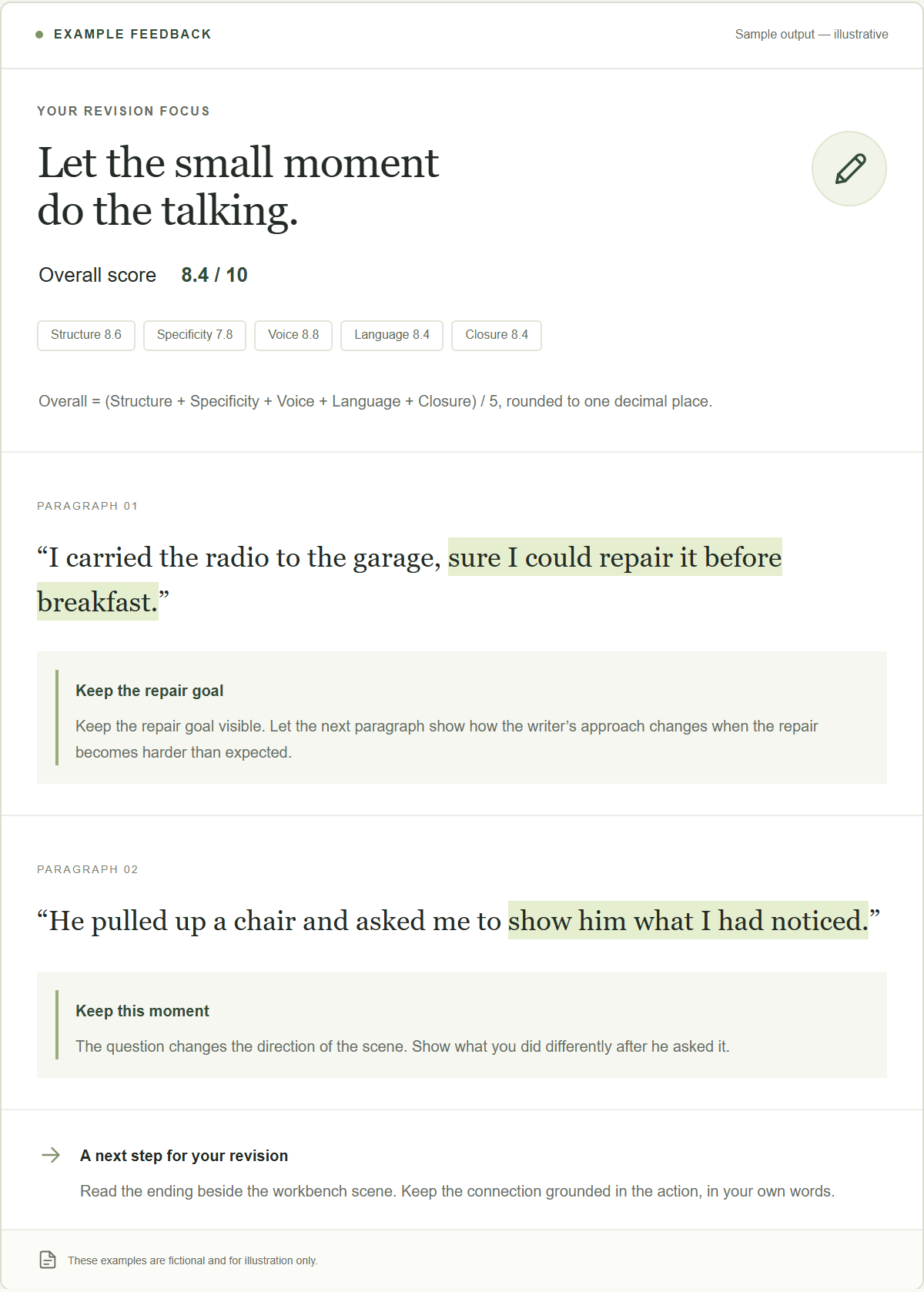
The screenshot shows a fictional workbench scene with a comment beside a particular exchange. Read the highlighted words and the annotation together. The comment asks what the writer did differently after the exchange, keeping attention on a change the draft can actually show.
How to use the feedback
Read the question before reading the draft again. Notice what the question asks you to explain, then locate the passages where your essay responds. Keep the difference between an experience and your understanding of it in view: a reader can follow an event without yet knowing what it means to you.
When considering a revision, return to the particular moment you meant to describe. Avoid borrowing a conclusion simply because it sounds impressive. Compare the proposed change with the language around it and with the experience you actually want to convey. Keep only wording that represents that experience accurately.
Keep the application’s current instructions available while editing. Common App publishes its prompts on its own website, and your application is the place to confirm the requirements that apply to you. The Common App prompts guide discusses the themes with a link back to that official source.
Common mistakes
- Turning the essay into a résumé. A succession of achievements can take up the space intended for the experience and perspective that respond to your selected question.
- Forcing an uplifting ending. An announced lesson may feel detached when the events on the page do not support it. Read the final passage alongside the scene it follows.
- Choosing a question after ignoring its wording. A broad topic label does not include every part of a prompt. Keep the complete official question beside the draft while checking the response.
- Assuming every difficulty needs a dramatic resolution. Describe the experience accurately rather than changing it to fit an expected story shape. The significance belongs to your perspective.
- Spending the whole draft explaining the background. Notice how much of the writing establishes context and where your own actions and observations appear. Read those parts together.
- Adding reflection that could belong to any story. Locate the experience behind a general statement. Decide whether the words explain your response to that particular experience.
- Accepting language that obscures your perspective. A revision can sound smoother while becoming less representative of what you mean. Read it aloud in the context of the draft.
- Treating a word counter as submission validation. The counter helps you draft, but the application’s own instructions and checks govern the submitted essay. Review the final text there.
When to use
Use this review when you are working on the main Common App personal essay and want to keep its selected question visible. Use Essay Grader to consider the general areas of structure, specificity, voice, language, and closure. Use Admission Essay Review for its separate focus on responding to the question and the impression left by a draft. You can compare these review scopes in the essay review tools overview.
Frequently asked questions
How does a Common App essay grader use the prompt?
The selected prompt gives a review its context. Structure, Specificity, Voice, Language, and Closure stay the same across questions and receive equal weight. Narrative, reflection, identity, and setbacks help explain what to examine within those dimensions. The displayed feedback is a fictional sample. Compare the annotation with its passage rather than treating its scores as results for the text you enter.
Can I use the same draft for different Common App prompts?
Read the draft against the wording of the prompt you intend to choose. Related experiences may fit different questions, but the response still needs to answer the selected question. Do not choose solely because a topic label sounds close. Compare the experience, the question, and what you actually explain in the writing.
How long can a Common App essay be?
The main personal essay has a 650-word limit, as described in Common App’s published application materials. Confirm the instructions shown in your own application before submitting. The counter in this workspace is a drafting aid and may handle punctuation differently. It does not replace the application’s own validation or word count.
Does a Common App essay need to list achievements?
A list of accomplishments can leave a reader without a sense of the experience being described. Read the question you selected, then consider which parts of the draft respond through your own perspective. An achievement can supply context, but its name or result alone does not explain what you noticed or understood.
Can AI feedback check whether an essay sounds like me?
A model only sees the writing and context supplied to it. It cannot establish your identity or independently know how you speak. Use comments as a reason to reread a passage yourself. If a revision sounds unfamiliar, compare it with your own language and decide what accurately represents your experience and meaning.
Should my Common App essay end with a lesson?
The question you choose and the experience you describe shape what the ending needs to do. The specified review flags a forced uplifting conclusion as a concern. Examine whether the final statement follows from the actual draft. Avoid adding a lesson simply because you assume every personal narrative must announce one.
Can I upload my Common App draft for review?
You can import a plain text file into the editor or paste the draft directly. Check that the paragraphs and punctuation appear correctly after importing. Keep your selected question beside the text while reading it. The fictional example is a separate illustration of feedback and does not represent an assessment of your entered draft.
Does the grader submit anything to Common App?
Admissa is independent of Common App and does not submit an application. Review your final essay in the application you use to submit it. Check the selected question, final text, paragraph breaks, and submission instructions there. A separate writing workspace does not replace the application platform or its own final checks.
How can I revise reflection without sounding forced?
Look at what the draft already shows you noticing, reconsidering, or doing differently. Decide whether the language accurately expresses that experience. A revision should make your meaning clearer rather than add an emotion you did not describe. Keep the reflection tied to the particular action or observation that supports it.
Can a Common App essay score tell me where I will be admitted?
An essay review is not a college decision or an admission forecast. It examines a piece of writing within a defined scope. Colleges consider applications through their own processes, which this workspace does not reproduce. Focus on understanding the comments and deciding what to revise rather than treating a score as a verdict.