How it works
- Bring the question and your response. Paste the application question into the optional field, then paste or import the essay. Keep the wording of the question intact so its context is available.
- Examine the intended impression. This review is specified to focus on what remains with a reader and whether the draft answers the question. The example interface shows how passage-level comments can be presented.
- Decide what to clarify. Compare a comment with what you hoped the passage would communicate. Revise in your own words, and reread the result together with the question and the rest of the essay.
Read the question as a set of requests, then locate the words that answer each request. A passage can be memorable without making its relationship to the question clear. Use the sample annotation to see how a comment can point back to a specific exchange rather than judge the writer.
What we grade
Each review is scored on the five dimensions below, with a sample output shown.
| Dimension | What we measure |
|---|---|
| Structure | Paragraphs move the essay forward: an engaging opening, a meaningful turn, and a clear landing. |
| Specificity | Concrete, verifiable details support the writing instead of general statements. |
| Voice | The writing sounds like the author rather than a polished, generic composition. |
| Language | Sentences are clear, accurate, and concise, without unnecessary wording. |
| Closure | The ending reaches a specific insight rather than repeating a summary. |
Overall = (Structure + Specificity + Voice + Language + Closure) / 5, rounded to one decimal place.
For an application response, read the five dimensions alongside the actual question and the impression you intend to leave. Structure concerns how the response develops an answer. Specificity concerns the details that give that answer substance. Voice concerns whether the perspective belongs to the writer, instead of an imagined ideal candidate. Language concerns what a reader can understand from the sentences themselves. Closure concerns the particular insight the response leaves behind.
Before revising, finish reading the draft and write a short note about what you remember. Compare that note with the application question and with the intention you had when writing. If an achievement is memorable but its connection to the question is missing, look at the passage that should make that connection. Do not assume that adding another accomplishment will clarify the answer.
These are contextual revision questions within the shared rubric, not separate score categories or a model of a college's private decisions. Each dimension contributes equally to the overall score. Read the sample to understand how a comment connects a criterion with a particular passage.
Example feedback
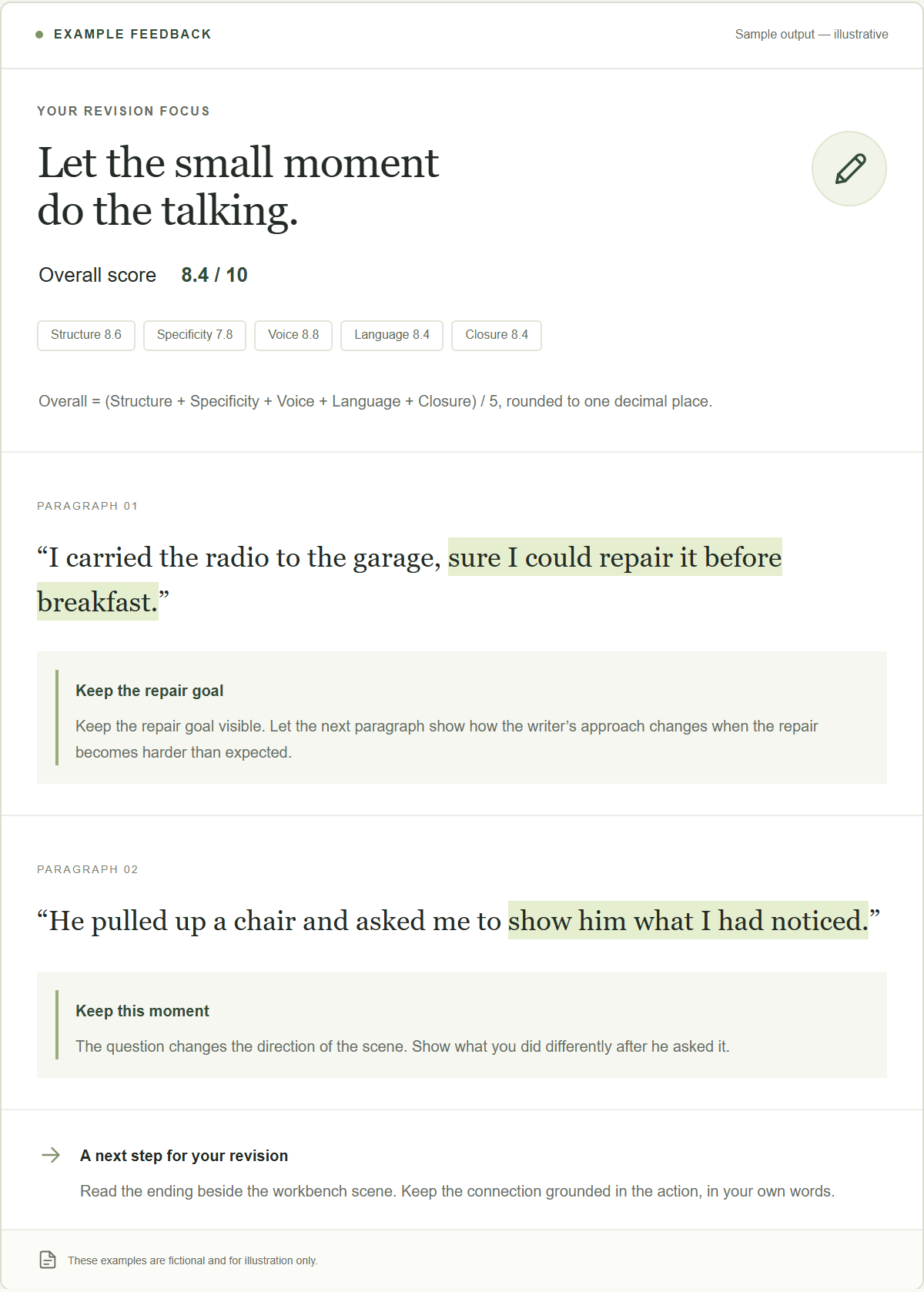
The screenshot presents a fictional draft and illustrative comments. It connects a passage with a revision focus so that you can read the evidence and the suggestion together. Consider what the annotation asks the writer to clarify, rather than copying a different voice into the essay.
How to use the feedback
Start with the impression you intended to leave. You might be able to explain that intention aloud more clearly than the draft currently expresses it. Compare the intention with the actual words, keeping the application question beside both. Look for the passage that carries the connection rather than assuming the reader will supply it.
A comment about prompt response concerns the relationship between the question and the writing. A comment about reader impression concerns what the writing makes available to remember. Keep those concerns separate while you assess a passage, then decide which words would make the connection clearer to someone reading it for the first time.
After revising, read the whole essay without stopping at each edit. Consider whether its purpose is clearer and whether the language still represents your perspective. A stronger connection between passages is useful only if it communicates what you intended. The writer, not the interface, makes the final decision about the submitted words.
Common mistakes
- Answering a different question. A related experience can still leave the actual prompt unanswered. Read the complete wording, including the parts that ask for explanation or reflection.
- Stacking achievements into a list. A sequence of accomplishments may explain what happened without revealing what you want the reader to understand about it. Keep the question in view.
- Assuming the reader already knows the context. A connection that feels obvious to the writer may not appear on the page. Check the words available to someone encountering the draft for the first time.
- Trying to sound like an imagined ideal applicant. Language chosen only to create an impression can obscure the experience you meant to discuss. Compare it with your own intended meaning.
- Treating a memorable detail as an answer by itself. An unusual event does not automatically explain its relationship to the application question. Read the detail beside the purpose of the paragraph.
- Replacing the draft with a suggested rewrite. A comment can raise a useful concern without supplying the wording you should submit. Consider the concern and make your own revision choices.
- Interpreting criticism as a judgment of the person. Feedback within this scope concerns a piece of writing. It cannot assess your worth or reproduce an institution’s decision process.
- Expecting the review to forecast an outcome. The tool’s intended purpose is to identify places to improve the draft. Admission decisions are outside the scope of the feedback.
When to use
Choose Admission Essay Review when your central question is whether an application response communicates what you intended and addresses its prompt. Choose Essay Grader for the general writing dimensions. Choose Common App Essay Grader for a draft responding to a selected Common App main essay question. The tools overview organizes tools by their review scope.
Frequently asked questions
What does an admission essay review look for?
The review examines whether a draft answers its question and what it leaves with a reader. Structure, Specificity, Voice, Language, and Closure provide the shared scoring framework, with each dimension weighted equally. Prompt response and reader impression guide the comments within that framework. The current example illustrates the format without evaluating your writing.
Is my essay reviewed by an admission officer?
The review framework uses AI feedback modeled on admissions criteria. It does not provide a review by an admission officer or speak for a college. Admissa is independent of colleges and application platforms. Feedback can support your revision decisions, but it cannot describe an institution’s private discussion of an application.
How can I check whether my essay answers the question?
Read the complete question beside the draft. Identify what it asks you to discuss and locate the passage that actually responds. A related topic does not necessarily answer every part of a question. If you can explain the connection only outside the essay, consider whether the text itself communicates what you intended.
Can an admission essay review improve my admission chances?
A review can help you identify places in the writing to reconsider, but it does not establish an effect on admission chances. An essay is one part of an application, and institutions use their own processes. Judge feedback by whether it helps you understand and revise a passage rather than by an outcome claim.
Should I include my activities in an admission essay?
An activity may belong in an essay when it helps answer the question you selected. The specified review concern is an accumulation of achievements without a clear response. Consider what the passage reveals about your experience and perspective. Listing an activity by itself does not explain why it matters within this particular essay.
What if my essay seems clear but forgettable?
Decide what you wanted a reader to carry away from the draft. Then look for the passages that communicate that idea through your experience. A reader’s memory cannot be reduced to a guaranteed formula. Use the shared dimensions to examine the impression of the writing and its supporting details, without treating the review as an admission prediction.
Can I use admission essay feedback for a supplemental response?
Keep the exact school question and its instructions beside the response. Check which parts ask for an experience, explanation, or connection to the school. General comments about clarity can be useful, but a short supplemental response still needs to answer its own question rather than imitate the structure of a longer personal essay.
How should I respond to feedback I disagree with?
Return to the words the comment discusses and decide whether the reader could reasonably understand them differently from your intention. You may keep the passage when it expresses your meaning accurately. You may also clarify it without accepting suggested wording. The essay remains your work, and feedback is one perspective on that work.
Can I share my admission essay review with a parent?
You can read the fictional sample together to discuss how an annotation relates to a passage. Keep a copy of your own writing when asking someone to read it, and identify the question you want to discuss. The sample scores describe the fictional example, so do not present them as results for your essay.
What happens after I paste an admission essay?
The text appears in the editor and the word counter updates as you write. You can switch to Example feedback to inspect a separate fictional draft with illustrative scores and comments, then return to your own text. Keep your own saved copy and review paragraph breaks before using the draft elsewhere.